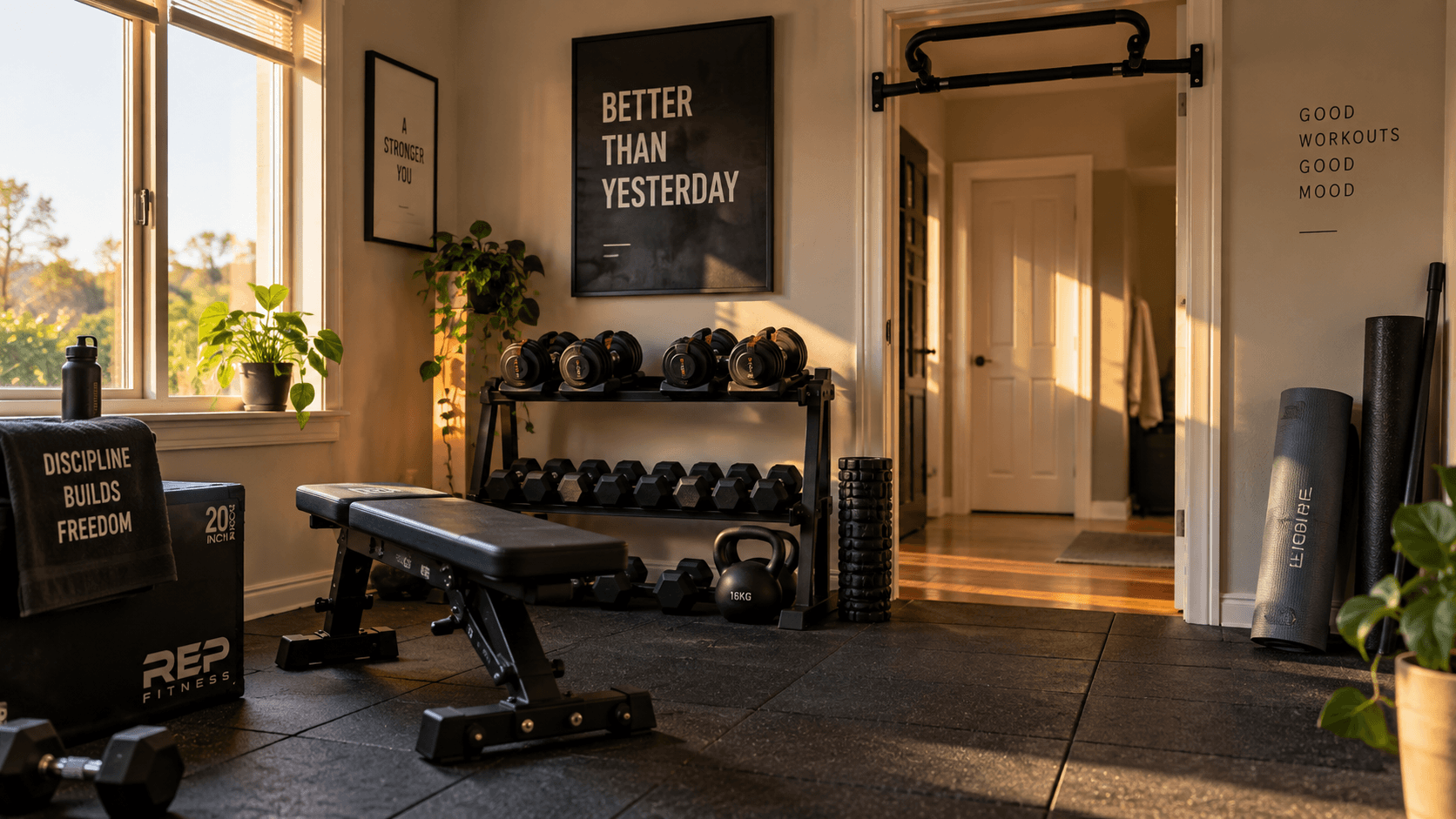
My first home gym was a $40 set of resistance bands and a pull-up bar I jammed into a doorframe that wasn’t quite wide enough. It worked. Not perfectly — the bar left marks on the trim and I nearly launched myself into the hallway more than once — but it worked.
That was eleven years ago. Since then I’ve helped well over 300 clients build home gyms across every imaginable situation: studios, garages, basements with low ceilings, spare bedrooms that had to pull double duty as guest rooms. I’ve seen what works. I’ve seen what people regret buying. And I’ve noticed the same mistakes come up time and time again.
This guide is everything I know about starting a home gym in 2026 — without wasting money, without buying things you won’t use, and without needing a spare $5,000 lying around.
Is a home gym actually worth it in 2026?
Depends who you ask — but for most people, yes. Decisively.
The average commercial gym membership in the US runs $40–$80 per month. That’s $480–$960 every year, indefinitely. A properly built home gym, even a mid-range one, pays for itself inside 18 months and trains you for free after that. The math is fairly simple.
What’s less obvious is the time argument. Studies consistently show that the #1 reason people skip workouts isn’t motivation — it’s logistics. Commute time, parking, waiting for equipment, finding a clean changing room. When your gym is 20 feet from your kitchen, those friction points disappear. And fewer friction points means more sessions per week, which means better results. It’s not complicated.
The equipment market has also genuinely improved. Adjustable dumbbells are more compact and reliable than they were five years ago. Foldable power racks actually fold now. Resistance bands don’t snap as quickly as the cheap ones used to. You have more quality options at more price points than any generation of home gym builders before you.
One honest caveat: if you thrive on the social energy of a commercial gym, the classes, the community — a home gym won’t replicate that. Know yourself before you invest.
Step 1 — Figure out your space first
I cannot stress this enough. Buy equipment before you measure your space and you will almost certainly regret at least one purchase.
Grab a tape measure. Write down the actual dimensions. Don’t estimate — measure. Height counts too, especially if you’re considering overhead pressing or a pull-up station.
| Available space | Realistic equipment | What won’t fit |
|---|---|---|
| Under 50 sq ft | Bands, dumbbells, mat, doorframe pull-up bar | Racks, benches, cardio machines |
| 50–100 sq ft | Adjustable dumbbells, bench, bands, compact foldable rack | Full power rack, treadmill |
| 100–150 sq ft | Power rack, barbell, bench, one cardio machine | Multiple cardio pieces |
| 150+ sq ft | Almost anything | — |
Working with under 100 square feet? Don’t assume that means a bad gym. Some of my clients’ most-used setups are tight spaces with smart, space-efficient choices. Check out the small apartment home gym guide for specific layouts that actually work.
One thing nobody mentions in these guides: ventilation. Training in a closed, unventilated room is genuinely unpleasant and can get dangerous in summer heat. Before you commit to a space, check that you can get airflow — a window that opens, a fan mount point, or an external door. Garages especially need this consideration.
Step 2 — Pick your budget tier honestly
Here’s what I’ve learned about budgets after over a decade of this: people usually know what they can actually spend. The problem is they get talked up or talked into aspirational setups they can’t realistically afford yet. So be honest with yourself about the number, then work within it.
Starter tier: $150–$300
This is not a compromise gym. It’s a starting gym. You can get genuinely fit in here.
- Resistance bands (loop set + tube set with handles) — $30–$50
- Adjustable dumbbells or fixed pair at your working weight — $60–$150
- Quality exercise mat — $25–$45
- Doorframe pull-up bar — $25–$40
Total: roughly $140–$285. That covers pulling, pushing, hinging, squatting, and core. Every major movement pattern. Full article on the best home gym setup under $300 if you want the specific product picks.
Mid-range tier: $500–$1,000
This is where I’d put most people with a serious interest in long-term training. Adjustable dumbbells that grow with you, a proper bench, better flooring, a band set that includes heavy options. You’re not compromising on anything at this level.
Serious tier: $1,500–$3,000+
Power rack, barbell, plates, bench, cardio piece of some kind. At this point you’re building something that could genuinely replace a commercial gym for most training goals. The adjustable dumbbell guide covers which sets are worth the investment at this tier.
Step 3 — Match equipment to your goals
This is the step most guides skip. Equipment choice should follow training goal, not the other way around. People buy what looks impressive, then try to build a program around it. Backwards.
Ask yourself: what are you actually trying to achieve? Fat loss? Muscle building? General fitness and endurance? Sport-specific conditioning? Mobility and injury prevention? The answer genuinely changes what you should buy first.
- Fat loss + conditioning — resistance bands, adjustable dumbbells, jump rope. You don’t need heavy weights to lose fat. You need training frequency and a calorie deficit.
- Muscle building — adjustable dumbbells or barbell + plates, bench, pull-up station. Progressive overload requires progressively heavier loads over time. Plan for that ceiling before you buy.
- General fitness — dumbbells, bands, mat, pull-up bar. The classic combo. Covers everything without specialising in anything.
- Cardio focus — a quality treadmill, stationary bike, or rowing machine as the anchor piece, supplemented by bands and a mat. Check our foldable treadmill guide if space is tight.
Step 4 — The equipment that actually matters
I’m going to be direct here. The fitness equipment industry makes money by convincing you that more equipment equals better results. It usually doesn’t. What matters is the right equipment — used consistently, over time.
The non-negotiables for almost everyone
Adjustable dumbbells. The most versatile piece of home gym equipment per square foot in existence. Curl them, press them, row them, goblet squat them. One set covers 80% of exercises. See the full adjustable dumbbell guide for what to buy.
Resistance bands. Underestimated by beginners, loved by experienced trainers. They add variety, assist pull-up progressions, and work muscle groups dumbbells miss at certain angles. The resistance band buying guide breaks down the three types and what each does.
A quality exercise mat. Not a yoga mat from a discount store. Something 6mm thick with real grip. You’ll use it for stretching, floor work, core exercises, and as a protective layer under equipment. The best yoga mats guide has tested picks at every price point.
Pull-up bar. Upper back and bicep development without it is genuinely harder. A doorframe bar costs $25–$40 and lasts years. Worth every penny.
Things that sound essential but usually aren’t (yet)
A bench — useful but not essential to start. You can floor press. A power rack — only necessary if you’re barbell squatting or benching alone with heavy weight. A cardio machine — if you’re not specifically training for cardiovascular endurance, the money is usually better spent elsewhere first.
Step 5 — Setting it up so you actually use it
Here’s something they don’t tell you: gym psychology is real. The way a space looks and feels has a measurable effect on how often you show up to train in it.
Good lighting matters. Overhead fluorescents in a cold garage feel like punishment. A couple of LED strips or a bright floor lamp changes the atmosphere entirely. Keep the space dedicated — don’t let it become general storage with a dumbbell in the corner. When you walk in, it should feel like a gym, not a spare room with fitness equipment in it.
Have your equipment visible and accessible. If your dumbbells are buried behind boxes, you’ll skip the workout. Set up a basic dumbbell storage stand or even a shelf. Make it easy to grab and go.
Temperature. If you’re in a garage, a basic space heater for winter and a fan for summer is $60 well spent. You won’t train consistently if the environment makes training miserable.
Mistakes I see constantly
Buying too much too fast. Enthusiasm is high at the start. People spend $2,000 in week one and train for six weeks. Buy the minimum viable setup first, use it consistently for three months, then add equipment based on what you’re actually missing.
Choosing equipment that doesn’t match their training style. If you hate steady-state cardio, a treadmill will collect laundry. Know yourself.
Ignoring the floor. Training on bare concrete is rough on joints and genuinely uncomfortable. Rubber tiles or horse stall mats are cheap and transformative. Budget $60–$150 for flooring before anything else.
Buying cheap resistance bands. The $8 bands you find on discount sites snap. They always snap. Mid-session. Often at full stretch. It’s startling and occasionally painful. Spend $15–$25 on a quality set and inspect them before every session.
Not measuring ceiling height. If you’re over 6 feet tall and your ceiling is 7.5 feet, overhead pressing is uncomfortable and pull-ups might not be possible depending on the bar mounting. Measure before buying.
Frequently Asked Questions
How much does it cost to start a home gym?
A functional starter home gym — resistance bands, adjustable dumbbells, a mat, and a pull-up bar — can be built for $150–$300. A mid-range setup with quality adjustable dumbbells, a bench, and proper flooring runs $500–$1,000. A serious setup with a rack, barbell, and cardio piece is $1,500–$3,000+. You don’t need the most expensive tier to get excellent results.
What is the most important piece of home gym equipment to buy first?
Adjustable dumbbells. They cover the widest range of exercises across all muscle groups, scale with your strength over time, and replace an entire rack of fixed weights in a compact unit. If you can only buy one thing, buy adjustable dumbbells and supplement with resistance bands.
How much space do I need for a home gym?
The minimum usable space is roughly 6×4 feet — enough to lie down, extend your arms, and perform floor-based exercises. A functional dumbbell and band setup works in 50 square feet. 100+ square feet opens up benches and compact racks. You can build an effective gym in a spare bedroom, but measure before you buy anything.
Is a home gym better than a gym membership?
For most people who train consistently, yes — financially and logistically. A home gym pays for itself within 12–18 months versus ongoing membership costs, eliminates commute time, and removes scheduling friction. The exception is people who rely on the social environment of a gym for motivation, or those who need specialist equipment (olympic lifting platforms, climbing walls, pools) that can’t be replicated at home.
Leave a Reply